
Efficiency range
The separation processes and their efficiencies depend on suspension properties such as consistency and flake and debris content. The same processing stages may be used several times in a stock preparation line, depending on the type and quantity of contaminants, to provide better effectiveness and increased reliability of processing machinery
Figure 1 shows the efficiency scatter of various separation processes vs. debris particle size. The separation efficiency of cleaners is excellent at large particle sizes if their density differs sufficiently from that of water and wetted fibres. Otherwise, the separation effect can decrease almost to zero.
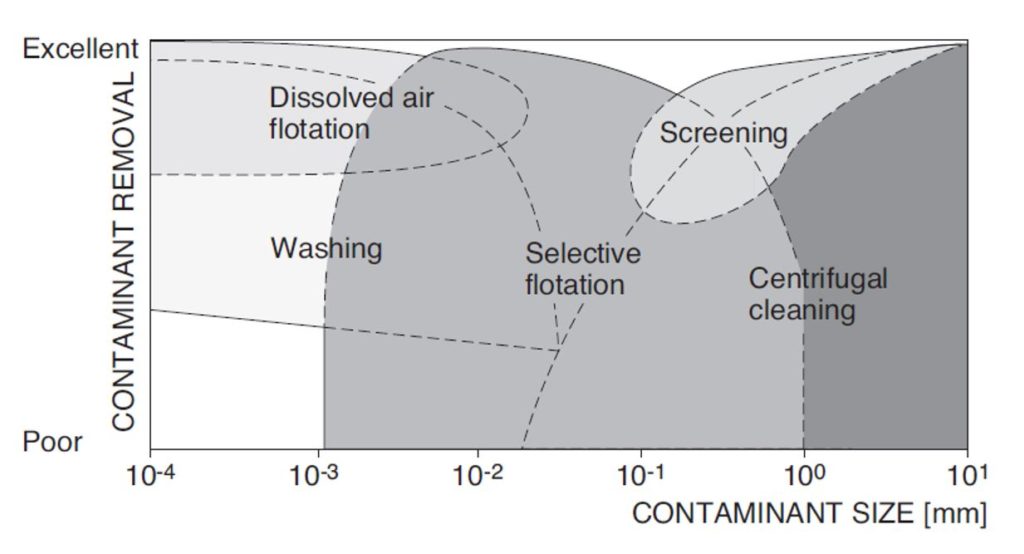
Large cubic particles are very well separated during screening, whereas small, flat or deformable particles are hardly separated at all in this process step. Flotation removes only hydrophobic particles but with great efficiency and over a wide size range. Hydrophilic particles remain in the suspension. Washing removes small particles. The efficiency depends on the amount of extracted water. Dissolved air flotation (DAF) or microflotation separates small particles very efficiently.
Main operating parameters of separation processes
lmportant criteria for evaluating the efficiency and cost-effectiveness of each processing stage are the specific energy consumption and stock consistency range. As shown in Table 1, these may vary widely. This may be due to the widely differing technology available. The primary reason is that the energy consumption depends strongly on how much work has occurred in the previous stages for deflaking and contaminant removal and on the requirements placed on the pulp slurry in the downstream process stages. The figures do not include the energy consumption for pumping the pulp slurry from one process step to another.
Table 1. Specific energy consumption and operating consistency of unit processes in recycled-fibre processing., incl. pumps directly connected with the processes
| Unit process | Specific energy demand (kWh/t) | Operating consistency (%) |
|---|---|---|
| Slushing pulper | LC:10-20 / HC: 25-40 | 3-20 |
| Drum pulper (screening) | 20-30/40 | 15-25/(3.5-6) |
| Deflaking | 20-60 | 3-6 |
| Coarse Screening | 15-25 | 3.0 -5.0 |
| Fractionation / Fine Screening | 20-30 | 2.0-3.5 /1.0-2.0 |
| Washing | 5-12 | 0.7-3.0 → 5-8 |
| Dissolved air flotation (DAF) | 10-20 | <0.3 → 0.01 |
| Flotation (selective) | 15 – 35 | 1-1.6 |
| LC-Centrifugal cleaning | 7-16 | 0.8-2.0 |
| Thickening– drum thickener– disc filter | 1-30.3-1.0 | 0.5-3 → 4-60.5-1.5 → 10-12 |
| Dewatering -Screw press | 7-10 | 4-12 → 25-30(35) |
| Dispersing | 30-120 | 25-32 |
| Refining LC (per SR unit) | 3-25 | 3-5.5 |
| Refining HC (per SR unit) | 10-60 | approx. 30 |
Source https://forestbiofacts.com/
Case
-
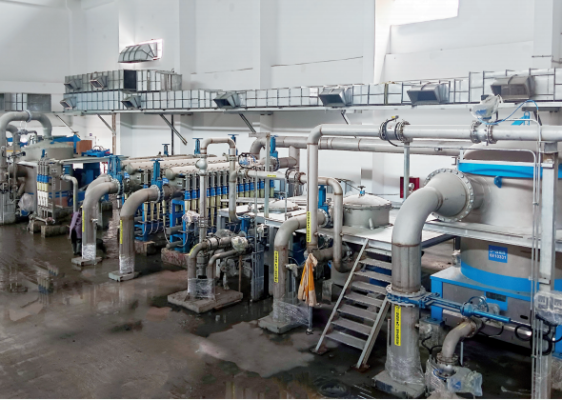 Yunda’s Complete Stock Preparation System for Jinlong’s 6600 mm Packaging Paper Project Enters Commissioning Stage
-
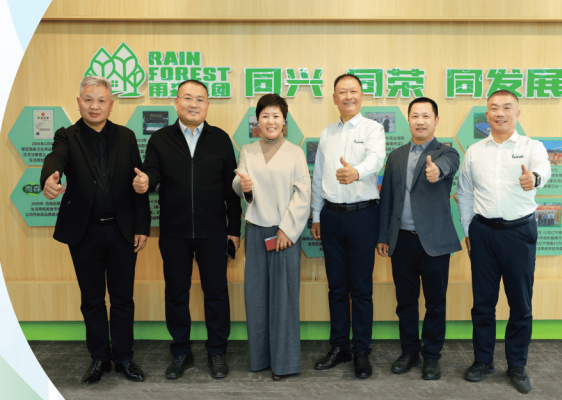 Yunda Secures Orders for Premium Tissue Paper Projects at Two Yusen Group Production Bases
-
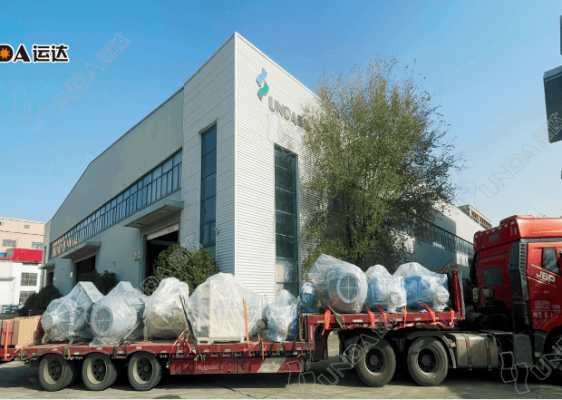 Yunda Successfully Ships the Complete Stock Preparation System for Hengan Group’s Tissue Paper Project
-
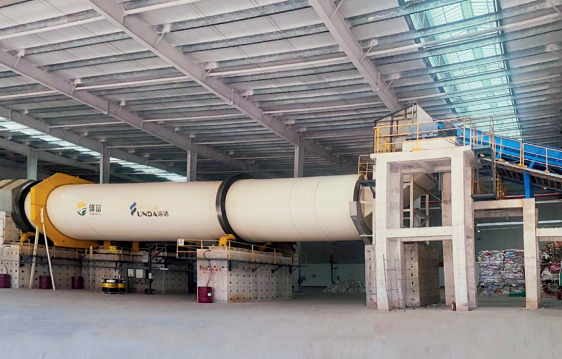 Yunda’s Complete Stock Preparation Systems for Guangxi Xiongfu Paper’s 300,000 t/a Grayboard Paper Project Successfully Start Up
-
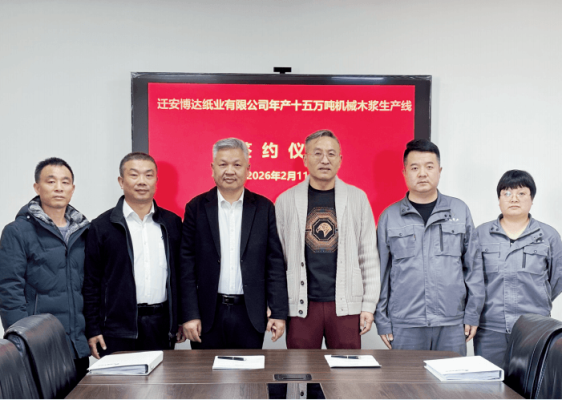 Yunda Wins the Full-Line Pulping Equipment Order for Qian’an Boda’s 150,000-Ton Bleached Chemi-Thermomechanical Pulp (BCTMP) Project
-
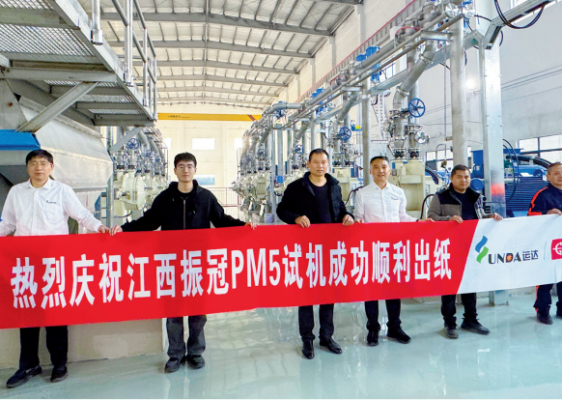 A Great Start! Yunda’s Complete Stock Preparation System Supports Successful First Paper Production on Jiangxi Zhenguan PM5
-
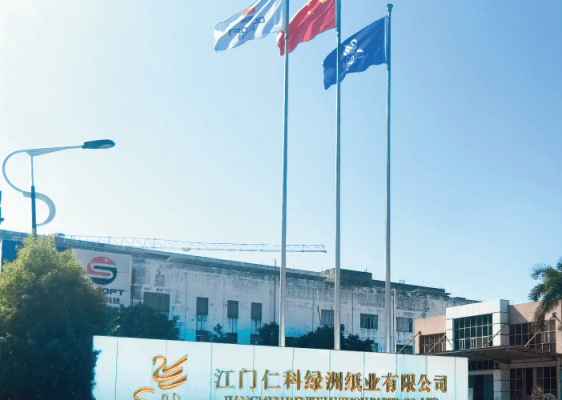 Yunda Successfully Starts Up Complete Stock Preparation and Approach Flow Systems for Jiangmen Renke Oasis 80,000 TPA Tissue Paper Project
-
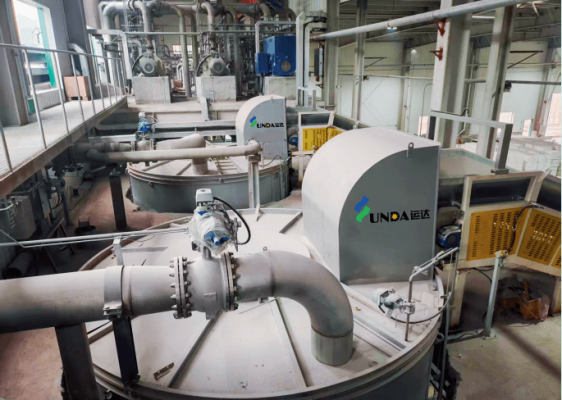 Successful Start-Up of Taisheng Group’s Tissue Paper Project in Guizhou
-
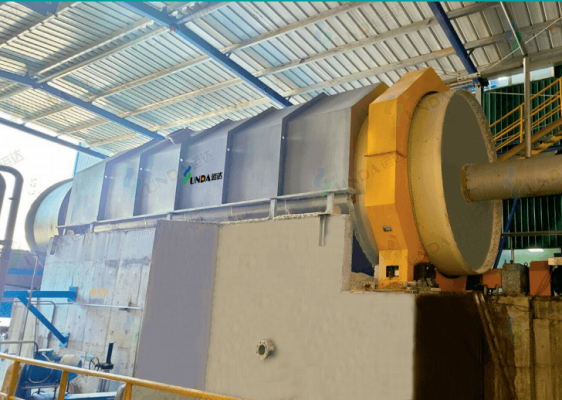 Taisheng Group’s Tissue Paper Project in Jiangxi Successfully Starts Production
-
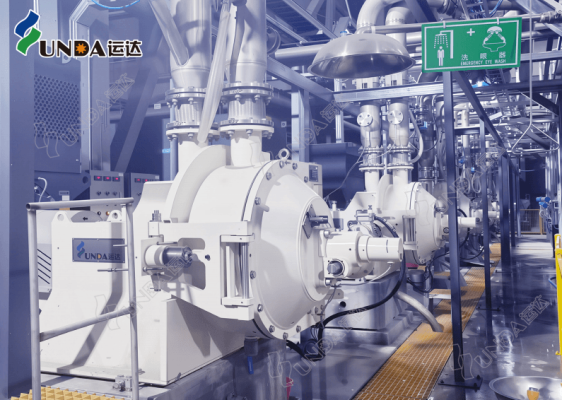 Sun Paper 300,000 TPA Tissue Project (Phase II) – Complete Pulping System Successfully Started Up